



21 Jul Reciprocity and Extraterritoriality in Workers’ Compensation Laws
Reciprocity and extraterritoriality are related concepts in workers’ compensation law that determine which state’s workers’ compensation system applies when employees work temporarily outside their home state.
Extraterritoriality
Extraterritoriality refers to a state’s ability to extend its workers’ compensation coverage beyond its borders. It allows an employee who is hired or principally employed in one state to remain covered by that state’s workers’ compensation law while temporarily working in another state.
For example:
- An employee is hired and regularly works in Ohio but is sent to Indiana for a three-week project.
- Ohio’s workers’ compensation law may continue to cover the employee during the temporary assignment.
- If the employee is injured in Indiana, benefits would be provided under Ohio law.
- How long the employee may work out of state.
- Whether the work must be temporary.
- Whether the employee was hired in the home state.
- Whether the employee’s principal place of employment is in the home state.
Reciprocity
Reciprocity is an agreement or statutory provision under which one state recognizes the workers’ compensation coverage provided by another state and exempts the employer from having to secure separate coverage in the host state.
For reciprocity to apply:
- The employee’s home state must provide extraterritorial coverage.
- The host state must recognize that coverage.
- The work in the host state must generally be temporary.
- The employer must have workers’ compensation insurance in the home state.
- A contractor based in Kentucky sends employees to Tennessee for a two-month project.
- Kentucky workers’ compensation insurance follows the employees into Tennessee.
- Tennessee recognizes Kentucky’s coverage through reciprocal provisions.
- The employer does not need to purchase a separate Tennessee workers’ compensation policy for that temporary work.
Key Difference
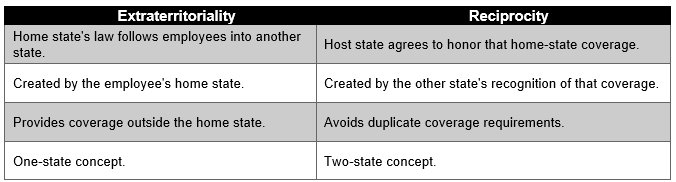
Example:
Suppose a Michigan employer sends an employee to Wisconsin for six weeks:
- Michigan’s workers’ compensation law provides extraterritorial coverage.
- Wisconsin has a reciprocity provision recognizing Michigan coverage.
- If the employee is injured in Wisconsin, the claim may be handled under Michigan workers’ compensation law.
- The employer generally does not need separate Wisconsin workers’ compensation insurance for that temporary assignment.
Practical Concerns for Employers
Employers with employees who travel or work across state lines should:
- Review the workers’ compensation laws of every state where employees may work.
- Ensure all applicable states are listed in Item 3.A. (for known exposures) and Item 3.C.
(for unknown or unexpected exposures) of the workers’ compensation policy. - Understand that reciprocity rules vary significantly from state to state.
- Recognize that some states, such as Ohio, are monopolistic states requiring coverage through the state fund. (the 90-day rule)
- Be aware that employees may sometimes have the option to pursue benefits in more than one state. (Thus, the importance of 3.C.)
- Consult legal counsel or workers’ compensation specialists when employees frequently cross state lines.